Traveling to Europe with a dog may sound complicated and daunting, it sure did to me the first time I did it! But with the right planning, it can be smooth and stress-free. My dogs have traveled multiple times to and from Europe. We have traveled from Mexico and the USA to Europe, so I hope our experience helps you bring your pet along on your European adventure!
From paperwork and vaccinations to dog-friendly destinations and hotels, here’s your complete guide to making your European adventure unforgettable for both you and your furry friend.

Can You Bring a Dog to Europe?
Yes! Many travelers bring their dogs to Europe every year. I have moved a total of 5 dogs to Europe, and have traveled to and from Europe with them over the years.
To travel to Europe with a dog, you’ll need to follow specific requirements set by the European Union and individual countries. This ensures your dog is healthy and safe to travel.
Dog Travel Requirements for Entering Europe

To travel to the European Union and Schengen Area with a dog, you’ll need:
- Microchip – ISO-compliant microchip implanted before rabies vaccination. Make sure it is the ISO-compliant as there are is at least another North America one specific that is not.
- Rabies Vaccination – at least 21 days before departure or proof of up-to-date vaccination schedule.
- Animal Health Certificate (AHC) or EU Pet Passport – issued by an accredited veterinarian. EU Pet Passport is required for residents, while non EU residents can travel with a EU health certificate that has dog, owner, health, microchip, and rabies information. This certificate cannot be more than 10 days old from the day of arrival to the EU. The EU certificate is valid only for a period of 4 months from issuance or until rabies vax expires, whichever happens first.
- Rabies antibody titration test– taken by an authorized vet at least 30 days after the anti-rabies vaccination and not less than 3 months before traveling to the EU. Country of origin specific, check if the country you are traveling from requires it. NOT required if coming from USA, Canada, Mexico, Argentina, Japan, UAE, Australia, New Zealand, among others.
- Declaration that pet is non-commercial– for non EU citizens. Complete and attach a written declaration that states your pet is traveling to Europe for non-commercial reasons.
- Tapeworm Treatment –Echinococcus multilocularis treatment needed for certain countries like Croatia, Finland, Ireland, Malta, Norway and Northern Ireland. Check country specific information here.
👉 Tip: Begin preparing the paperwork at least one month before your trip to avoid last-minute stress.
Travel Requirements for Leaving the EU with a pet
To leave the EU, make sure you have the documentation needed for the country you are going to as airlines will ask for it.
Go to your local vet for an updated health certificate or sign the EU Pet Passport in the appropriate sections, including the exportation certificate. My vet also had the part for internal and external deworming signed for when Mishka and I went to Mexico City.
You may be able to use your AHC to leave, but some countries may need a more current one. For example, Mexico requires the health certificate to be no older than 15 days.
The United States requires a CDC Dog Import Form when coming from a rabies-free or low-risk country, which the EU/Schengen qualifies as such. It is free and lasts for 6 months. Complete it before travel as airlines will ask for it before being allowed to check-in to leave Europe with your dog.
Flying to Europe with a Dog
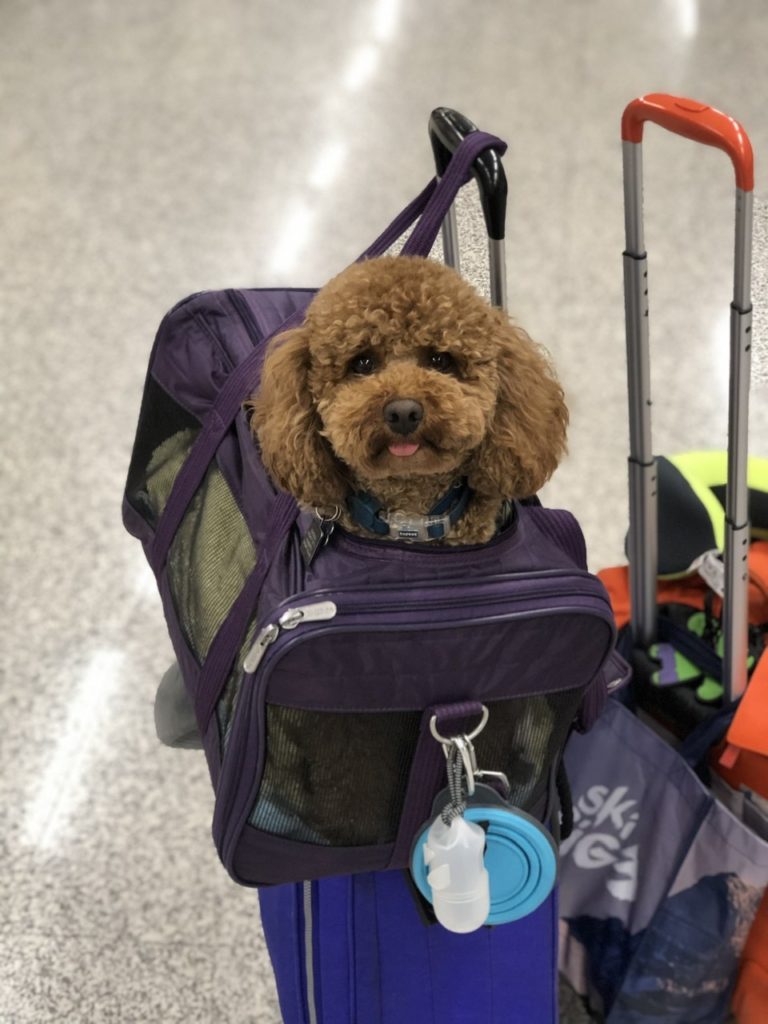
You will want to make sure your dog is ready for travel. This post will show you how to travel with your dog on a plane. After you’ve learned the basics of pet air travel, you need to choose how you are going to travel to Europe with your dog.
Choosing the right airline is crucial. You will most likely NOT want to send your dog with your suitcase, but bring them in-cabin with you. The first time I traveled with dogs to Italy, I sent Timon and Groot in the cargo hold. Sometimes, that is the only option, especially when pet specific airlines are still too expensive.
Some airlines do not accept pets in the cargo hold, like United or American Airlines. And they all have restrictions on the amount of pets allowed to travel on specific routes and class and breed restrictions, such as no brachiocephalic dogs.
Most airlines will not allow sedated dogs, even with veterinary approval. These natural calming chews have worked well for me, but check with your vet before giving them to your dog!
👉Tip: Make a reservation for your dog when you book or as soon as possible after you book your own flight!
Best Airlines for Dogs Traveling to Europe
- Lufthansa – Excellent reputation for pet safety and care. Both cargo and in-cabin options. Up to 8kg with carrier and €115 for in-cab in pets. €170 for medium sized and €340 large dogs each way in hold.
- KLM – Cabin and cargo options —with some aircraft restrictions— for dogs and a fee of €70 to €500 per one-way flight. Up to 8kg with carrier for in-cabin dogs.
- Air France – both in-cabin and cargo hold options and price differs depending on origin/destination with most international flights having a flat rate of €400 in the hold and €200 in the cabin.
- Iberia – in-cabin up-to 8kg and price differs depending on origin/destination with direct flights from America and Asia costing €180 each way and €200 each way on connecting flights. For bigger dogs, they work with Woof Airlines who will also transport brachycephalic dogs.
- ITA Airways– both in-cabin and in cargo. Flights within Italy allow for up to 12kg in-cabin for €73, while international only 10kg and prices vary depending on origin/destination.
- Turkish Airlines- Both cargo and in-cabin options. Up to 8kg with carrier. If transiting, I have not needed titer test. Istanbul airport has multiple pet-relief areas and they were relatively clean.
- United Airlines– only in-cabin. No weight restrictions but dog must fit comfortably within the carrier size and costs $150 each way.
👉Tip: Whenever possible, book a direct flight if possible to reduce stress on your dog.
Packing Checklist for Dogs Traveling to Europe
When traveling internationally with a dog, pack essentials to keep your pet safe and comfortable:
- Airline-approved carrier or crate
Most are around 27cm (11in) height, 45cm (18 in) length and 27cm (11in) width. I’ve used this Amazon Basics one on multiple airlines without an issue. Soft-sided carriers are easier to fit under the seat. - Required documentation
Check the requirements for entry into the EU. - Copies of veterinary paperwork
Have a printed copy and digitized as well. - Collapsible food and water bowls
I also recently bought this stainless steel pet bottle that kept the water cool on a hot hike near Rome. - Dog food and treats
You cannot bring in more than 2kg but it’s enough for the trip or to buy some food in Europe. Major brands are easily accessible everywhere. - Medicines and prescription (if applicable)
- Favorite toy or blanket for comfort
Mishka has blankets he loves and we travel with one for bedtime. - Waste bags and wipes
Always clean up after your dog! We try to do our part by using compostable poop bags and travel wet wipes. - Paw washer
City streets can be extremely dirty and since we let our dogs sleep with us, we like using this paw washer to really clean their paws after every walk. - Collar, leash, and muzzle
Make sure the collar has an ID with a working phone number during your trip. I’ve never had to use the muzzle, but have one as it is the law in many places. - Pet First Aid Kit
Always have a first aid kit just in case. Add pet specific things or get a pet first aid kit.
- Brush, shampoo, scissors
If you have a velcro dog like Mishka, a brush, scissors and some shampoo are essential on trips to get all the stickies out. - Local Vet List
Have one just in case. At least of emergency vet hospitals. Check here for Croatia vets.
Best Dog Travel Gear (that we use!)
Airline approved dog carrier: Amazon Basics pet carrier is light and has survived about 4 years of travel
For car safety: Kurgo crash tested harness and the Sleepypod Air dog travel bag doubles as a car seat
Water safety: Lilo inherited this Kurgo life vest from Mishka when I got this adorable shark fin dog life vest for him
First aid kit: I originally bought the Kurgo and have been refilling ever since, but this pet first aid kit is very complete
Cleanliness: we use this paw washer EVERY SINGLE DAY because streets in Rome are dirty
Basics: compostable poop bags and travel wet wipes
Hydration: especially during the summer, this stainless steel pet bottle has been great to keeping their water cool
Dog backpack: we bought this Kurgo dog carrier backpack as both a carrier for trains and ferries, but also as their dog suitcase!
Best Dog-Friendly Countries in Europe

Some European countries are especially welcoming to dogs. Here are the top destinations for pet-friendly Europe travel:
- Italy – Dogs are part of daily life. While most museums and historical sites will not allow pets, you can take your dog to restaurants, bars, supermarkets, and national parks. We took Mishka and Lilo to Pompeii, the Dolomites, and Lake Garda!
- Germany – Excellent public transportation rules for dogs and plenty of green spaces.
- Switzerland – Hiking, lakes, and dog-friendly trains make it a top choice.
- France – Dogs are welcome in many cafés, shops, and even some museums.
- Croatia – we loved our roadtrip around Croatia because of its gorgeous coastline with many dog-friendly beaches, many dog friendly activities, and being able to visit Plitvice with Mishka and Lilo. Croatia was more dog friendly than we expected and you’ll love visiting Pula, Split, and other great cities.
👉Tip: Research locations before you go. Check out the rest of the dog travel blog!
Getting Around Europe with a Dog

Public transportation in Europe is surprisingly pet-friendly. Dogs have to be on a leash at all times and some countries, like Italy, require a muzzle. Even if I’ve never seen it enforced, travel with one just in case.
- Trains – In most countries, small dogs travel free in a carrier and without reservation, while larger dogs require a reduced ticket. In Italy, we have never been told to put them in their carriers even though it is required and one time I was able to put Timon who weighed 20kg in a duffel bag. No one batted an eyelash or cared.
- Ferries— Some ferry lines will charge for all dogs, some only for larger dogs, and others will allow all dogs to travel free of charge. In theory, dogs are only allowed on decks or designated pet cabins, but that is also something that is mostly enforced during high season and for disruptive pets. On our ferry from Venice to Pula we sat inside and had our dogs outside the carrier and sleeping on my lap. Even though the ferry was full and it was high season, no one told us to go outside to the deck or put them inside their carriers.
- Metro & buses – Small dogs in carriers are widely accepted. In both Croatia and Italy we have gotten on city buses and metro without a carrier without issues. In Split, the bus was very full and no one said anything! Our dogs are also small, so it helps. In some places, large dogs aren’t technically allowed. Bus companies like Flix do not allow the transport of pets so traveling around Europe might be better on trains.
- Taxis & rideshares – Always ask the driver if pets are allowed before booking. Some taxi apps like IT Taxi in Italy has the option of adding dogs when you book to make sure you get a dog friendly driver. Uber Blacks have all accepted me and my dogs without issue.
- Air travel within Europe- budget airlines like Wizz Air or Ryan Air will not allow pets, unless they are service dogs. Non-budget airlines do allow both in-cabin and cargo hold pets. While Italy passed new rules that had every pet owner in Italy excited. The reality falls short. The rules allow dogs heavier than 22lbs to travel but left it up to each individual airline to decide their own policies, which is already the case.
- Car– you can easily rent a car in Europe and drive around. It is the easiest way to visit national parks and move from city to city or country to country, especially if you have a bigger dog.
👉Tip: For safe car travel, we always buckle up our dogs with the Kurgo crash tested harness and the Sleepypod Air dog travel bag doubles as a car seat! And put their life vest on when on a boat!
Dog-Friendly Hotels in Europe

When searching for dog-friendly accommodation in Europe, use filters on booking.com or Vrbo. You’ll find a range of options, from luxury hotels to budget stays. You can check out my favorite pet-friendly hotels in Croatia here.
Look for:
- Clear “pets allowed” policy. Sometimes smaller hotels don’t have this listed on their website or even on booking websites. I have emailed or called properties with no clear pet policy to make sure dogs are allowed. Last December my dad had booked all the hotels on our roadtrip around Italy forgetting about Mishka and Lilo. I called and only one wasn’t pet friendly so we had to rebook. We even stayed in the Relais Balcone di Giuletta in Verona which gave you a special key to Juliette’s courtyard and set up dog beds for our dogs!
- Outdoor space nearby. Book close to a park or a property with a yard so it makes early morning walks easier.
- Reasonable or no pet fees. Most accommodations either have no pet fees or a max pet fee of €20.
👉Tip: Contact rental properties, as they might not list as pet friendly but if you ask, they might allow your dog. I found some of our accommodations in Croatia this way.
Tips for Traveling to Europe with Your Dog
- Train your dog for travel to Europe with this guide
- Begin preparing the paperwork at least one month before your trip to avoid last-minute stress
- Keep a digital and paper copy of all documents
- Make a reservation for your dog when you book or as soon as possible after you book your own flight
- Always book a direct flight if possible to reduce stress on your dog
- Book pet friendly accommodations and transportation
- Contact rental properties, as they might not list as pet friendly but if you ask, they might allow your dog
- Plan outdoor activities and dog-friendly sightseeing, check out my dog travel posts for ideas on what to do
- For safe car travel, we always buckle up our dogs with the Kurgo crash tested harness and the Sleepypod Air dog travel bag doubles as a car seat! And put their life vest on when on a boat!
- Bring their food to avoid upset stomachs
- Always check the local pet rules in each city or country
- Complete the packing checklist
Final Thoughts: Is Traveling to Europe with a Dog Worth It?

Absolutely. Traveling through Europe with your dog requires extra preparation, but the memories you’ll create are priceless. Imagine walking seeing the incredible waterfalls of Plitvice, walking along the remains of Pompeii, hiking through what seem like the Mordor Dolomites or sipping wine along the Seine.
With proper planning, your dog will be the ultimate travel companion—and Europe is ready to welcome both of you.
Amazing Dog Friendly Destinations in Europe
CROATIA
Croatia With Dogs: All You Need To Know To Travel With Your Dogs
9 Dog Friendly Activities In Croatia
Pet Friendly Beaches In Croatia
8 Best Cities In Croatia You Have To Visit With Your Dog
5 Reasons Why You Should Roadtrip Croatia With Dogs
What To Do In Split With Dogs: Top 5 Activities
Top 5 Activities In Pula, Croatia With Dogs
Plitvice Lakes With Dogs: A Guide To Exploring Croatia’s Natural Wonder
ITALY
Coming soon
More on Dog Travel
How To Travel With Your Dog: The Essential 5 Tips For Dog Air Travel
Travel To Europe With A Dog: Complete Guide For Easy Dog Vacations